Teamwork
Working together
Paired (2) is the default. Ensemble (3+) is encouraged. Solo (1) is visible, and still valid. These are not rules to follow but states the tool surfaces so the team can see how work is distributed.
One person works on one story at a time. No avatar on four different cards. Cognitive load is protected structurally.
On pair ownership
Two people own a story, they are responsible for it shipping. That does not mean they have to sit at the same keyboard for eight hours a day and "pair" on a markdown file.
The value is shared ownership of the outcome: design decisions together, tricky problems together, the routine parts divided sensibly. The tool does not track whether you are at the same screen. It tracks whether two people own the work.
One of the pair can be a QA. The QA pairs in at kickoff to shape the story, helping with edge cases, acceptance criteria, what "done" looks like, and adding some scenarios to the story, for example.
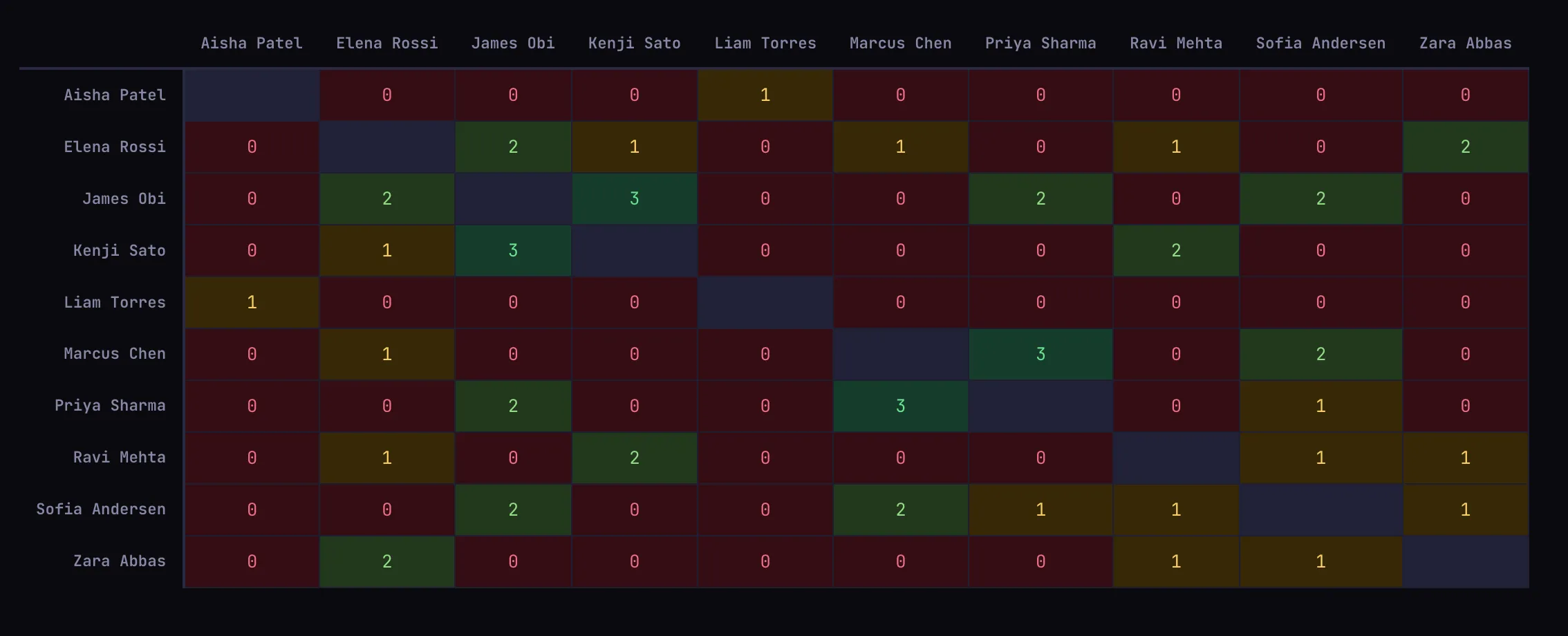
The pairing matrix
Who has worked with whom. Three lenses on the same data:
- Days - how long since each pair last worked together. Green is recent, warm is stale.
- Stories - how many stories each pair has shared. Volume.
- Current - who is paired right now. A blue dot means solo.
Never-paired cells are visible. Knowledge silos show up as gaps in the grid.
Ensemble timeline
When did three or more people work together? The timeline shows who worked together and when.
Solo log
Stories shipped by one person. Solo mode happens when someone leaves a pair.
Transparency and trust
Everyone in Mainline sees the same view. There are no manager dashboards, role-gated views, or individual metrics.
The account holder (buyer) cannot see team data unless they explicitly opt in and join the team as a practitioner.
On the panopticon
Bentham's panopticon is a prison where a central tower can observe every cell, but the prisoners cannot tell whether they are being watched. The possibility of surveillance is enough to control behaviour. Most workplace tools follow this model as management sees dashboards that the team cannot.
Mainline inverts this. Every view is the same view. If a manager can see who is paired with whom, so can every team member. If a reassignment is recorded, everyone sees who made it. The watcher is watched. Visibility is mutual or it's surveillance.
See the Tutorial for a walkthrough of how assignment and pairing work in practice.